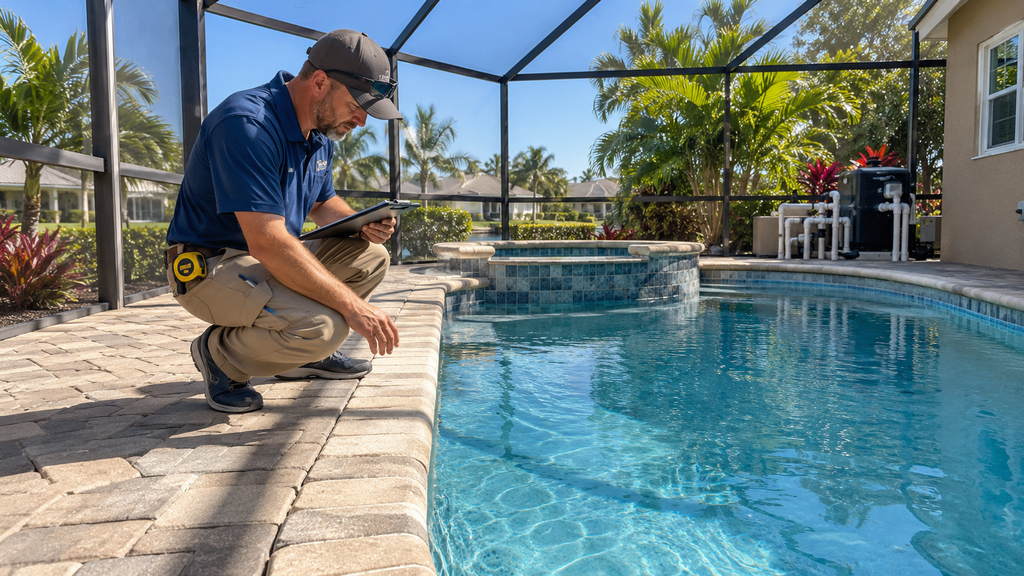
You’ve unpacked the car, opened the windows, and walked out to the lanai. The pool is either sparkling (nice) or a shade of green you don’t remember choosing. Either way, it’s worth spending an hour on this snowbird pool checklist before the first swim. Six months of Florida summer is hard on a pool, even one that had some care while you were gone, and a few problems don’t show up until you actually run the equipment.
Here’s what typically happens to a pool while you’re away, what to check on return day, and when it makes more sense to call someone.
The Short Version
- A Florida summer can leave a pool with low chlorine, high stabilizer (cyanuric acid), a dirty filter and timers reset by power blips.
- Before the first swim, check the water level, pump, filter and water chemistry, and test cyanuric acid, because very high stabilizer makes chlorine far less effective.
- Test the heater a week before you want warm water, since heaters that sat all summer can have ant nests in the controls or tripped safety switches.
- If children are visiting, check pool door and window alarms, self-latching gates and drain covers before they arrive.
- Call a pro if you can’t see the bottom of the pool, the pump won’t prime, or you find storm damage.
What a Sarasota Summer Does to an Unattended Pool
From May to November, your pool deals with the hottest water temperatures of the year, near-daily afternoon storms, and at least one or two tropical systems. That combination causes a predictable set of problems:
- The water level swings. Evaporation on hot, windy days can take a quarter inch or more a day, and a single summer storm can put it right back and then some. If the level dropped below the skimmer at some point, the pump may have run dry.
- Chlorine gets used up fast. Heat, sunlight and rain all burn through it. Once chlorine runs low for even a few days in August, algae gets a foothold.
- Stabilizer quietly builds up. If a floater or feeder was dosing chlorine tablets all summer, it was also adding stabilizer (cyanuric acid). Too much stabilizer makes chlorine far less effective, so a pool can look fine on a chlorine test and still grow algae.
- Power blips reset things. A summer outage can leave timers, automation and salt systems running the wrong schedule, or not at all.
- Critters move in. Frogs and lizards end up in skimmers, and in Florida it’s common to find ants nesting inside warm electrical boxes on pumps and heaters.
Your Snowbird Pool Checklist for Return Day
1. Look before you touch anything
Walk around the pool and the equipment pad first. You’re looking for anything summer storms may have left behind: torn screen panels, debris in the water, cracked coping, a loose screen enclosure frame, or a waterline on the equipment showing it sat in floodwater. If you find storm damage, stop here and have it checked by a professional before turning anything on.
2. Check the water level
The water should sit about halfway up the skimmer opening. Too low, and the pump can suck air and run dry, so top it off before starting the equipment. Too high after a rainy fall, and the skimmer can’t pull debris off the surface. Lower it to the middle of the skimmer, but only that far.
3. Empty the baskets and check the pump
Empty the skimmer basket and the pump basket (turn the pump off first). Then run the pump and watch it for a couple of minutes. It should prime, meaning the lid fills with water and the air bubbles stop, within a few minutes. Listen for grinding or screeching, and look for drips around the pump and plumbing. A pump that hums but won’t start, or won’t prime, needs a technician.
4. Clean the filter
After a summer of pollen, storms and leaves, the filter is almost certainly dirty. Check the pressure gauge. If it reads 8 to 10 psi higher than its clean starting point, backwash a sand or DE filter, or pull and rinse cartridges. If cartridges are torn, crushed or permanently brown, they’re due for replacement.
5. Test the water, including stabilizer
Test strips will give you a rough idea, but a proper test kit or a water test from your pool pro is worth it after a long absence. Check free chlorine, pH, alkalinity, calcium hardness and, most importantly after a summer on tablets, cyanuric acid (stabilizer). If stabilizer is very high, adding more chlorine won’t fix much. The usual solution is replacing part of the water, which should be planned carefully in Florida’s high water table. If the water is cloudy but the numbers look fine, this post on how to fix cloudy pool water walks through the usual causes.
6. Brush, then shock if needed
Brush the walls, steps, benches and waterline, even if they look clean. Algae often starts in shady corners and behind ladders. If you see any green, yellow or dark spots, or the chlorine was near zero, shock the pool and keep the pump running around the clock until the water clears and the chlorine holds overnight.
7. Check the salt cell (saltwater pools)
Salt systems often report low salt or stop producing chlorine after a long summer, usually because heavy rain diluted the salt or because the cell plates are coated in white calcium scale. Check the salt reading, look inside the cell if it’s clear, and clean it following the manufacturer’s instructions if it’s scaled.
8. Reset timers and automation
Confirm the time on the timer or automation panel, and set a winter schedule. Most pools can run fewer hours in the cooler months than in August. If you have an app-controlled system, make sure it still connects. Power outages and router changes often knock it offline.
9. Fire up the heater before you need it
Don’t wait for the first cold front to find out the heater doesn’t work. Turn it on a week early. Heaters that sat all summer can have ant nests in the controls, corroded igniters, or tripped safety switches. Heat pumps also slow down noticeably on the coldest mornings, so if you want warm water for the holidays, start heating a few days ahead.
Grandkids Coming? A Quick Safety Check
If young children are visiting over the holidays, take ten minutes to check the safety features before they arrive. Florida’s Residential Swimming Pool Safety Act requires new home pools to have at least one approved safety feature, like a barrier, a safety cover, or door and window alarms. After six months away, make sure yours still work:
- Test door and window alarms that lead to the pool area. Batteries die over the summer.
- Check that gates to the pool self-close and self-latch.
- Make sure the pool fence or barrier has no gaps or damage from summer storms.
- Confirm the drain covers are in place and not cracked.
- Put pool toys away when the pool isn’t being supervised. They’re the main reason small kids lean over the edge.
When to Call a Pro Instead
Most of this checklist is doable yourself if you’re comfortable with it. Call a pool company if:
- You can’t see the bottom of the pool.
- The pump won’t prime, makes grinding noises, or trips the breaker.
- You find storm damage to the equipment, the pool shell or the screen enclosure.
- Stabilizer is very high and the water needs a partial drain and refill.
- The heater won’t fire or keeps shutting off.
- The finish is stained, rough or peeling after the summer. That may be the moment to look at resurfacing.
Our pool repair and maintenance team can handle the whole startup in one visit: equipment check, filter clean, water balance and heater test. Call 941-366-6267.
Planning for Next Spring When You Leave Again
The easiest return day is the one you plan when you leave. The biggest difference between a pool that comes back clean and one that comes back green is regular care while you’re gone. With weekly pool service, a technician checks the chemistry, cleans the baskets and filter, and catches problems early. Our service updates after each visit mean you can see from Ohio or Ontario that the pool was serviced and what was done.
If you’ll handle it yourself or with a neighbor’s help, our post on keeping your pool clear while you’re away covers the basics.
Frequently Asked Questions
Should I turn off my pool pump while I’m away for the summer?
No. In Florida’s heat, a pool without circulation turns green quickly. Run the pump on a timer every day, and have someone check the chemistry at least weekly.
Why is my pool green even though the chlorine was working?
After months of chlorine tablets, stabilizer (cyanuric acid) can build up so high that chlorine stops working well. Test for stabilizer. If it’s very high, part of the water usually needs to be replaced.
How long does it take to get a green pool clean after returning?
A lightly green pool usually clears in a few days with brushing, shocking and continuous filtering. A dark green or black pool can take a week or more and often needs professional cleanup.
Do I need to do anything to my pool heater before winter?
Yes. Test it a week before you want warm water. Heaters that sat all summer often have problems like ants in the controls or tripped safety switches, and it’s easier to fix them before the first cold snap.
Back in town and not sure where to start? Call Gettle Pools at 941-366-6267 or book a season startup visit.